There are thousands of dead ground squirrels attached to your avocado toast. That’s not a metaphor. Every avocado orchard has to be protected from ground squirrels, and that protection means killing them in massive numbers. If you’ve ever chosen avocado over eggs because you thought it was the cruelty-free option, you were making a decision based on a story that falls apart the moment you step onto an actual farm.
I recently had Mollie Engelhart, of Sovereignty Ranch, on the podcast, and this conversation brought a few more of the food industry lies to the forefront. Mollie wasn’t some outsider criticizing veganism from the sidelines. She was one of the most well-known vegan chefs in Los Angeles. She had five restaurants, a passionate following, and a $31 million acquisition deal on the table. Mollie lived and breathed the philosophy of “do no harm” for years, built her entire career on it, and promoted it to thousands of people who trusted her.
Then she bought a farm. And everything she believed about food started to collapse.
The Lie Underneath “Cruelty-Free”
When Mollie began farming, she wanted to grow vegan vegetables. That was the plan. But the deeper she went into how food is actually produced, the more she realized that the construct of cruelty-free food doesn’t exist. It never did.
Here’s what most people don’t know. All organic produce, every head of lettuce, every bunch of kale, every bag of organic carrots, is grown with fertilizers made from bone meal, blood meal, and feather meal. Those ingredients come directly from the industrial feedlot system, the same system that veganism claims to oppose. The vegetables on your plate are fed by the same slaughterhouses you’re trying to boycott by not eating meat.
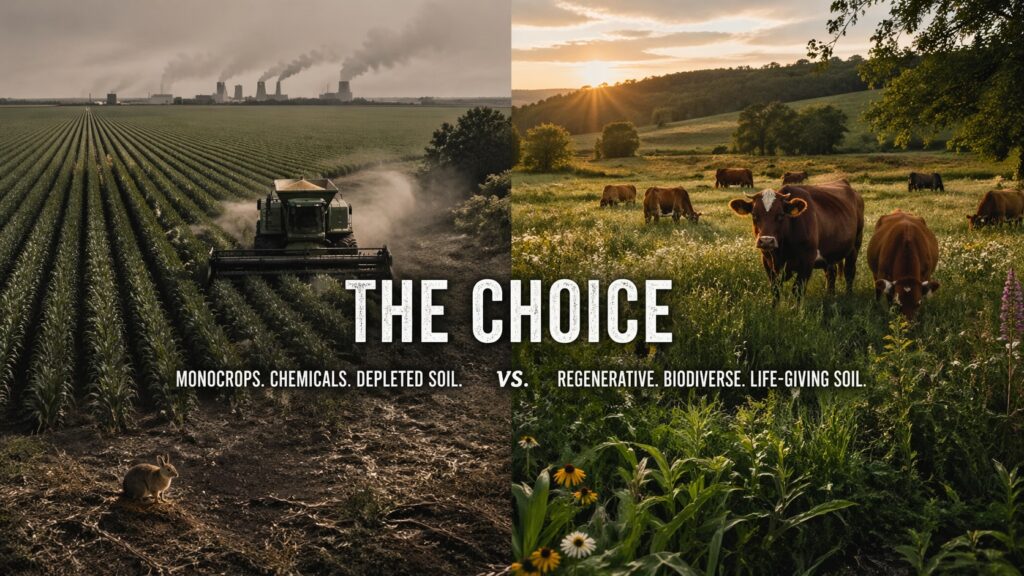
And it goes further than that. Monocrop agriculture, the system that produces the vast majority of plant-based food in this country, is one of the most destructive forces on the planet. It strips the soil of microbiology, depletes minerals, poisons waterways with synthetic nitrogen and pesticides, and kills enormous numbers of animals in the process. Rodents, birds, insects, and ground-dwelling creatures are destroyed by the millions every growing season so that fields of soy, corn, and wheat can be planted, sprayed, and harvested at industrial scale.
The harm doesn’t disappear because there’s no steak on your plate. It moves to a place where you can’t see it.
What Actually Heals People
Mollie made a point during our conversation that I think cuts through all the dietary noise. She’s heard people say they cured their cancer with a vegan diet or a carnivore diet. She’s also heard it from raw food advocates and paleo followers and every other camp. And her conclusion is simple: what healed them wasn’t the specific diet. What healed them was removing processed food.
That resonated with me deeply. I’ve spent years studying nutrition and talking to women who are struggling with their health. The one consistent truth I keep coming back to is that the body heals when you give it real, whole food the way it was designed to be eaten. A beet is good for you. Sugar extracted from a beet is not. Wheat that’s been freshly ground from the whole grain is a completely different thing from the bleached, refined powder that goes into most bread. The processing is the problem, not the food group.
Mollie doesn’t believe there’s one right diet for everyone. She thinks some people do well as vegetarians and others need meat. What she does believe is that the food has to be real, whole, and connected to the land it came from. And I agree with her.
Why Soil Health Is Everything
One of the most important parts of our conversation was about soil. Mollie practices regenerative agriculture on her ranch in Texas, which means she prioritizes the health of the soil above everything else. The principle is straightforward: if the soil is healthy, everything that grows from it will be healthy, and everything that eats what grows from it will be healthy too.
Here’s why that matters. Plants can’t make minerals on their own. They can only absorb minerals through a relationship with the microbiology in the soil. When that microbiology is destroyed by tilling, chemical sprays, and monocrop farming, the plants might still grow, but they’re nutritionally hollow. You can eat a head of broccoli from a conventional farm and get a fraction of the minerals your body needs compared to the same broccoli grown in living, biologically active soil.
We Are Part of the Land
The microbiology in the soil also has a direct relationship with the microbiology in your gut. They’re connected. When you eat food grown in healthy soil, you’re feeding your gut microbiome with organisms and compounds that support digestion, immunity, and hormone health. When you eat food grown in dead soil pumped full of synthetic fertilizers, you’re getting calories without nourishment, and your body feels the difference even if you can’t name what’s wrong.
This is why Mollie moved her entire life from Los Angeles to a ranch in Texas. She raises her own cattle from birth and moves them daily across the land in a pattern that mimics how wild herds would have moved, fertilizing the soil naturally as they go. Mollie grows cover crops, avoids tilling, uses no chemicals, and maintains biodiversity across the farm. When you eat at her on-farm restaurant, the burger on your plate came from a cow she raised, the bread was made with wild yeast she collected from the trees on her property, and the kimchi was fermented from cabbage grown in her own fields.
That’s what real food looks like. And it’s the opposite of what the industrial food system, both conventional and vegan, is producing.
The Cost of Believing the Story
Mollie’s story has a personal cost that’s hard to hear. When she tried to transition her LA restaurants from vegan to regenerative, keeping 70% of the menu vegan while adding the option of regenerative meat, the vegan community turned on her. They protested outside her restaurants for weeks, manipulated crowdsourced platforms to mark her restaurants as permanently closed on Google and Yelp, and got Yelp to remove 5,000 five-star reviews accumulated over 15 years and replaced them with one-star reviews calling her a murderer. She lost the restaurants and the $31 million deal that would have set her family up for life. And she started over at 47 years old on a ranch in Texas.
She told me she doesn’t regret it. What she regrets is that she spent years promoting a food philosophy built on a story that doesn’t hold up, a story that made people feel morally superior while the actual farming practices behind their food were just as destructive as the ones they were protesting.
What I Want You to Take From This
I’m not here to tell anyone what to eat. That’s never been my approach. But I do think we owe it to ourselves to look honestly at where our food comes from and stop accepting marketing language as truth. “Cruelty-free” is a label, not a reality. “Organic” doesn’t mean what most people think it means. And “plant-based” doesn’t automatically mean healthier or kinder.
What I care about is that the food you eat is real, that it was grown or raised in a way that supports the land and your body, and that you’re not making choices based on stories designed to sell you something rather than heal you. If this conversation made you uncomfortable, I’d encourage you to sit with that discomfort and then listen to the full episode. Mollie’s honesty is rare, and her perspective is one I think every woman who cares about her health and her food should hear.