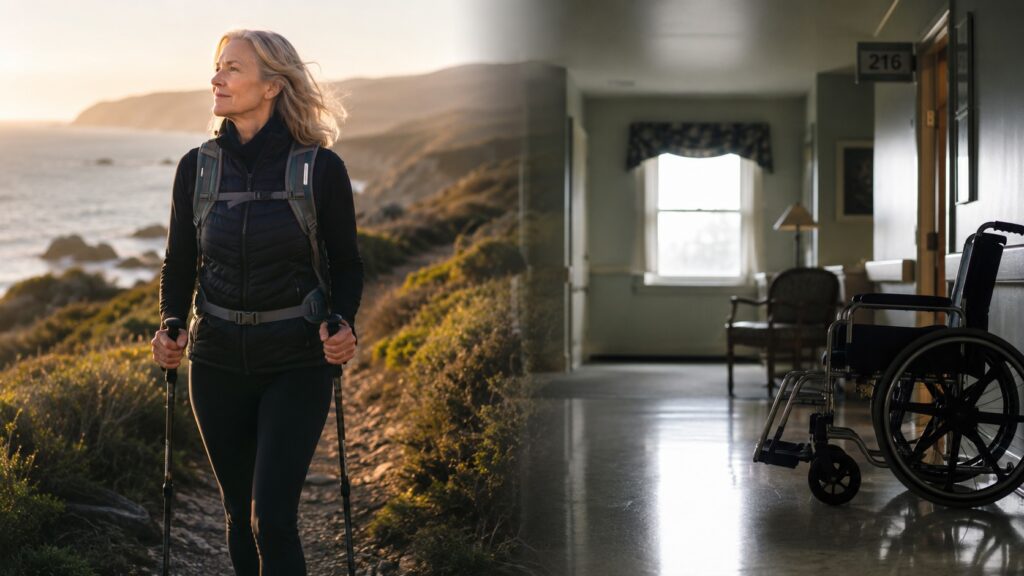
Why Your Reason for Exercising Matters More Than Your Routine
Most women I talk to know they should be exercising. They’ve heard it from doctors, friends, magazines, and probably their mothers. Knowing isn’t the problem. The problem is that knowing doesn’t get you off the couch on a Tuesday morning in February when it’s cold outside and your bed is warm and nothing in your body wants to move.
What gets you off the couch is something else entirely. It’s a reason. A specific, personal, almost stubborn reason that belongs only to you. And without one, no amount of good advice will keep you going past the second week.
I call it the carrot and the stick. Every woman who stays consistent with her health has both of them, whether she calls them that or not.
The Carrot
The carrot is the life you want. The life you want when no one is watching, the one that belongs to you and not to anyone’s expectations of you. For some women, it’s traveling into their seventies and eighties without needing help with their luggage. For others, it’s playing on the floor with grandchildren and getting back up without thinking about it. I have a friend whose carrot is skiing aggressive terrain into her sixties. Mine has always been hiking long distances in wild places and waking up the next day ready to do it again.
Whatever your carrot is, it needs to be specific. “Being healthy” doesn’t work. Your brain can’t picture it, and your body can’t feel its way toward it. You need a moving image of yourself doing something that matters to you, and you need to be able to call that image up when your motivation runs thin.
When you have that picture, exercise stops being punishment. It becomes the price of admission for the life you’re building. You lift weights because you want to lift your suitcase into the overhead bin at 75. You walk every day because you want to walk the coastline in Portugal at 70. The training and the life become one continuous thing.
The Stick
The stick is harder to talk about because it asks you to look at what you don’t want. Most of us spend a lot of energy avoiding that.
The numbers are worth knowing. About 70 percent of nursing home residents are women. Falls become the single biggest risk to independence after 65, and once a woman over 65 breaks a hip, her chances of full recovery drop steeply. We plan for our financial future. We open retirement accounts and meet with advisors. Far fewer women plan for their physical future with the same seriousness, even though the physical future arrives whether we plan for it or not.
The stick is your honest answer to a hard question. What does it look like if you don’t take care of your body now? Who has to take care of you instead? What does your life look like at 80 if you’ve spent the previous thirty years sitting? These are uncomfortable questions on purpose. Discomfort moves people. Comfort keeps them where they are.
For me, the stick has always been seeing women in their seventies who can’t get up from a chair without using their arms. I don’t want to be that woman. That image, sharp and specific, has gotten me to the gym on days when nothing else would have.
Why Both Matter
A carrot alone gives you something beautiful to move toward, but on hard days, beauty isn’t always enough. A stick alone moves you, but fear-based motivation burns out fast and leaves a bitter taste behind. You need both pulling in opposite directions, one drawing you forward and one closing the door behind you.
This is how habits become durable. The first month of any new fitness routine takes the most energy because you’re still convincing yourself every single day. After a month, the convincing gets easier. After three months, you stop arguing with yourself in the morning. You just go. The carrot and the stick have done their work, and momentum takes over.
I always tell women that the first step is the hardest part by a long stretch. Picking up the weight the first time. Walking through the gym door the first time. Putting on the shoes when every part of you wants to stay where you are. Once the train starts moving on the track, it gets easier to keep it moving than to stop it.
Your Why Will Change
The carrot and stick you start with may not be the ones you stay with. That’s how it should be. As your body becomes capable of more, your reasons grow with it. The woman who starts walking because she’s afraid of her cholesterol numbers may, two years later, be training for a hike in Patagonia. The reasons evolve because the person evolves.
What stays constant is the practice of having a reason at all. A specific one. One you can name when someone asks you why you bother. Health on its own is too abstract to pull you forward. Your why has to be something you can see, taste, and feel.
So sit with it. What is the life you want at 80? And what is the life you refuse to have? Write both of them down somewhere you can find them on the days you need them. The days will come.
On the Podcast This Week
This whole conversation about why we move and what motivates us was inspired by a recent episode with Beth Chamberlin. She played Beth Raines on Guiding Light for nearly 20 years before reinventing herself as a fitness and health coach and an advocate for women over 50. Beth picked up her first kettlebell at 41 during one of the lowest moments of her career, and that single decision changed the entire course of her life. She talks openly about the desperation that pushed her into the gym, the confidence she built once she started getting stronger, and the way her posture and self-worth grew together as her body did.
What I loved most about our conversation is how clearly Beth articulates the connection between physical strength and emotional resilience. She has lived it. She is now in her sixties, fit, confident, and recently recovered from a hysterectomy in a fraction of the time it would have taken most women her age. Her story is a living example of what happens when you find your why and act on it.
Beth holds retreats in Costa Rica. If you want to join or simply learn more about what she’s building, all the details are on her retreat site.
If you haven’t listened to our conversation yet, the link is below. It’s worth your time.