
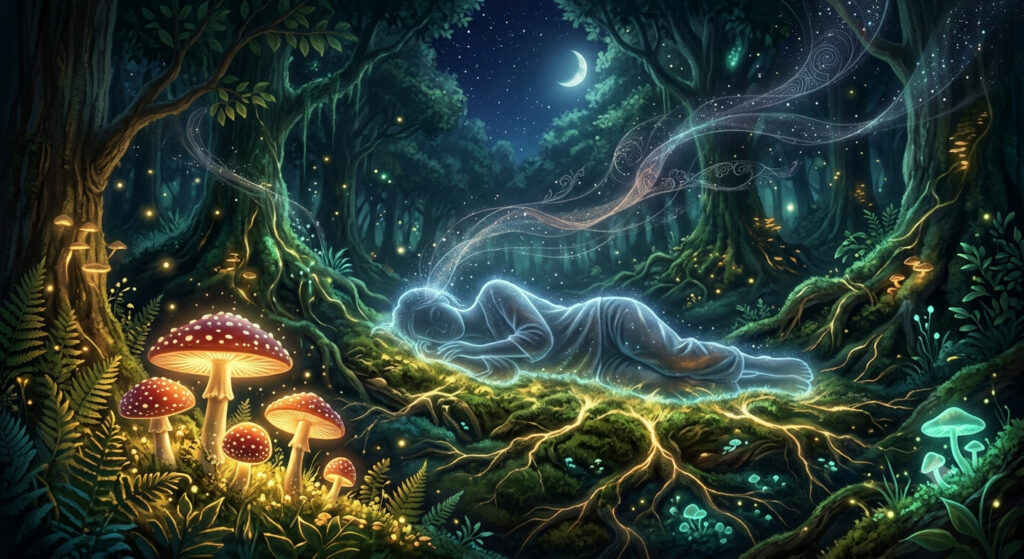
In an era defined by constant noise, information overload, and collective anxiety, many of us find ourselves trapped in a cycle of “fight or flight.” We are overstimulated, our nervous systems are taxed, and restorative sleep has become an elusive luxury. But what if the key to healing wasn’t found in a laboratory, but in the ancient, rhythmic connection between our bodies, the earth, and the landscape of our own dreams?
The Physiology of Stress and the Search for Stillness
To understand why we struggle to wind down, we must look at the dance of our neurotransmitters. Our brains operate on a delicate balance between glutamate—the “gas pedal” that keeps us alert and active—and GABA, the “off switch” that allows our central nervous system to shift into a parasympathetic, restorative state. In modern life, we are often driving through the day with our glutamate levels spiked, leaving our GABA pathways exhausted.
When we fail to shift into that parasympathetic state, we lose the ability to truly sleep. Sleep is not merely a period of downtime; it is an active physiological process. During deep sleep, our brains undergo a detoxification process, clearing away proteins linked to neurodegenerative conditions. Without deep, REM-rich sleep, we are unable to metabolize the emotions of the day, leaving us stuck in a loop of reactivity and rumination.
Earth Medicine: A Symbiotic Approach to Healing
Integration coach Lynda Samphire explores a unique, nature-based approach to recalibrating our internal state. She highlights the role of Amanita muscaria, a mushroom that has long held a place in human history. Rather than acting as a sedative that forces the body to shut down, this earth medicine is understood as a GABA agonist. When prepared with care, it signals the brain to move from a sympathetic, stressed state into a parasympathetic, soothing one.
This is not a “fix” in the pharmaceutical sense. It is an invitation. The mushroom, which shares a complex, symbiotic relationship with forest trees like spruce and fir, brings the grounding energy of the earth into our own nervous system. It acts as a bridge, helping us return to homeostasis—a state where we are grounded, present, and capable of co-creating our reality rather than simply reacting to the chaos of the world.
Dreams as an Untapped Resource
If we view sleep as our greatest untapped resource, then dreams become the language through which our psyche communicates. Often, we fear our dreams, especially when they take the form of nightmares or visions that feel too intense to handle. Yet, these experiences are often mirrors of our subconscious, surfacing emotions that are ready to be integrated.
When we approach our dream state with curiosity rather than fear, we can uncover deep-seated belief systems and traumas that hinder our growth. Whether it is ancestral wisdom surfacing during meditation or the feeling of “astral travel” as we drift off into the liminal space between waking and sleeping, our dreams offer a profound platform for self-discovery. By tracking our dreams, we gain insight into our internal patterns, turning the night into a space for healing and emotional resolution.
Redefining What It Means to Be Human
Ultimately, this work is about reclaiming our humanity. It is not about productivity, status, or constantly trying to “fix” ourselves. Being human means being fully present in the body, allowing divine wisdom to flow through, and accepting the contrast of life’s polarities.
When we stop trying to control the uncontrollable and instead move inward, we begin to see that we are part of a much larger, interconnected network. Just as the mycelial networks beneath the forest floor exchange minerals and support the health of the entire ecosystem, our own nervous systems mirror this complex, web-like connection to the earth. When we sleep, we align with the earth’s magnetic field, repairing our connection to the world around us.
Simple Steps Toward Restorative Living
If you find yourself struggling with anxiety or poor sleep, start with simplicity:
- Prioritize the transition: Use warm water in a shower or bath an hour before bed to signal to your nervous system that it is time to shift gears.
- Watch your intake: Be mindful of how late you eat, as an overworking gut contributes significantly to nighttime anxiety.
- Release the pressure: Stop trying to force sleep. The act of “trying to sleep” often creates the very insomnia we are fighting.
- Track your night: Keep a journal by your bed. Even if you don’t have a vivid dream, noting your feelings or the quality of your rest helps you establish a rhythm with your own subconscious.
By treating sleep as a sacred, intentional practice, we move away from the frantic pace of the modern world and back to the quiet, ancient wisdom that resides within us all.
Follow Lynda:
👉 Instagram: https://www.instagram.com/lyndasamphire/
👉 Website: https://www.lwsamphire.com/